Selecting the right finish for Extruded Polystyrene (XPS) insulation involves more than thermal performance. It represents a critical structural decision. XPS foam board surface finishes determine how well adhesives and renders stick to your insulation. Specifying the wrong surface often leads to catastrophic delamination in exterior finish systems. It can also cause unnecessary material waste in below-grade applications. This guide breaks down the mechanical differences between smooth and embossed options. We help contractors, architects, and builders match the correct board to their specific adhesion needs. You will learn how the extrusion process directly affects surface tension. You will also discover the best use cases for different panel textures. Finally, we explore implementation risks to ensure your next installation remains secure, code-compliant, and structurally sound for decades.
Key Takeaways
Performance Parity: Both smooth and embossed XPS offer nearly identical R-values and compressive strengths. The choice dictates mechanical adhesion, not thermal efficiency.
Smooth Surfaces: Retain the original manufacturing "skin," providing optimal water resistance for below-grade, cavity wall, and under-slab applications where no direct bonding is required.
Textured/Embossed Surfaces: The manufacturing skin is removed or stamped to create an "XPS foam bonding surface," which is mandatory for stucco, plaster, EIFS, or tile adhesives to achieve mechanical keying.
Failure Risks: Applying heavy renders or adhesives to a smooth XPS board significantly increases the risk of sheer failure and delamination.
1. The Manufacturing Skin: How Finishes Affect Adhesion
Understanding adhesion starts with the extrusion process. Manufacturers melt polystyrene resin and mix it with blowing agents. They force this mixture through a specialized die. As the polystyrene expands and hits the ambient air, it cools rapidly. This sudden temperature drop forms a dense, smooth outer layer. Industry professionals call this the manufacturing "skin."
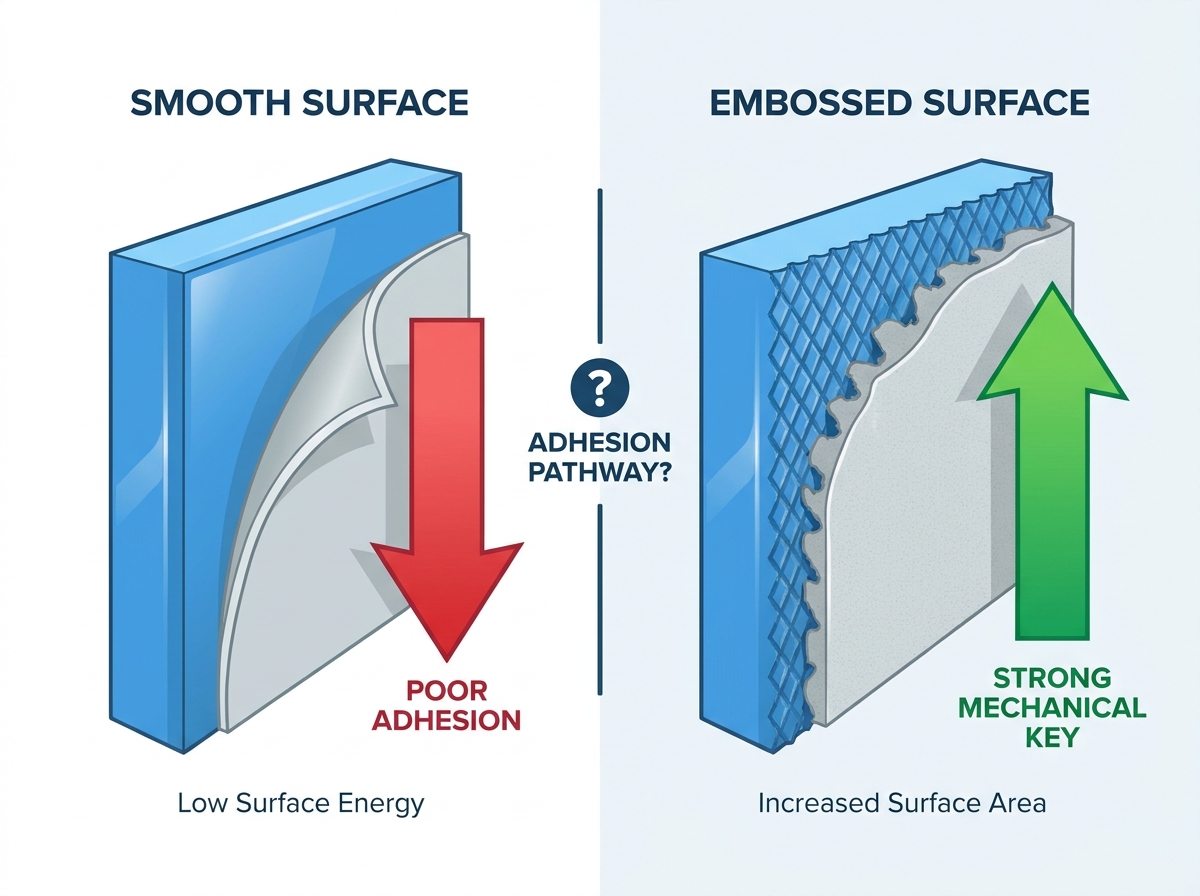
This skin fundamentally alters how the board interacts with liquids. A smooth skin possesses very low surface energy. This low surface tension causes wet mixtures to bead up. Cements, glues, and thick renders simply slide off the panel. Even if an adhesive cures, it cannot penetrate the dense outer layer. It merely rests on top.
Structural bonding requires a process called mechanical keying. Adhesives need physical pathways to grip the substrate. They require micro-abrasions or physical grooves to lock into place. Modifying the surface finish removes or alters the glossy skin. This modification creates the necessary friction. It forms interlocking pathways for adhesives to anchor themselves permanently.
A common mistake we see involves relying purely on chemical adhesives. Chemical bonds often fail under thermal expansion. Mechanical keying provides a physical safeguard. It ensures the render or glue physically integrates into the board.
2. Smooth XPS Foam Board: Best Use Cases & Limitations
The standard smooth XPS foam board remains the industry workhorse for specific applications. It provides excellent performance when you do not need direct chemical adhesion. Its intact outer skin offers distinct advantages in damp environments.
We recommend smooth panels for several ideal applications. You should specify them when structural weight or fasteners hold the board static.
Below-Grade & Foundation: Heavy soil pressure holds the boards against foundation walls. Installers use mechanical fasteners to keep them in place during backfilling. No chemical adhesion is necessary.
Under-Concrete Slab: The board acts as a continuous thermal break. The immense weight of the poured concrete keeps the insulation completely static.
Cavity Walls: Builders use smooth boards as loose-fill insulation. They also mechanically fasten them behind brick veneers or exterior siding.
Moisture resistance represents the biggest advantage of smooth panels. The intact extrusion skin slightly enhances the board's hydrophobicity. It makes a smooth panel highly resistant to ground moisture and capillary action. ASTM C578 standards highlight XPS for its low water absorption. The smooth skin maximizes this protective trait.
However, strict limitations exist. You face massive implementation risks if you use smooth boards incorrectly. Never specify smooth panels for Direct-Applied Exterior Finish Systems (DEFS). Do not use them for EIFS base coats. The heavy cementitious adhesives will inevitably fail. Wind loads and daily thermal expansion will shear the finishes right off the wall.
3. Embossed, Grooved, and Textured XPS Insulation Surface Options
Manufacturers alter the board surface to solve adhesion failures. They employ several secondary manufacturing processes. These processes create specialized textures for different construction needs. Each texture serves a specific structural purpose.
An embossed XPS board passes through heavy hot rollers during production. These heated rollers stamp a diamond or waffle pattern directly into the skin. This pattern maximizes the surface area. It creates perfect shallow pockets for thin-set mortars. EIFS base coats grip these embossed patterns securely.
Sometimes, projects demand even stronger adhesion. Manufacturers produce a textured XPS insulation surface by physically shaving the board. They plane or sand the outer extrusion skin off completely. This process exposes the internal open cell structure slightly. It allows maximum chemical adhesive penetration. Plaster and stucco lock into these exposed cells deeply.
Specialized heating and drainage systems require different modifications. A grooved XPS board features deep, channeled cuts. Manufacturers route these channels after extrusion. Installers typically use them for underfloor heating systems. The grooves hold radiant heating pipes securely. Builders also use grooved boards to create specific drainage planes in exterior cladding assemblies.
How do you choose? Assess your primary evaluation criterion. Look at the tensile adhesion strength requirements of your finish material. A heavy stone veneer requires a deeply planed surface. A lightweight EIFS mesh might only require a light diamond emboss.
4. Application Showdown: Matching Finish to the Project
Choosing the right finish prevents costly callbacks. We must match the surface texture to the specific project demands. The material applied over the insulation dictates your choice.
Consider EIFS and heavy render systems. These applications absolutely require embossed or planed boards. Base coats demand a high-friction XPS foam bonding surface. This friction supports the combined weight of the fiberglass mesh and the acrylic topcoat. Without it, the entire exterior cladding system sags.
Wet rooms and tiling projects present a different challenge. Ceramic and porcelain tiles are heavy and brittle. They require extreme rigidity. They also need a surface that accepts modified thin-set immediately. For this, you need a cement coated XPS tile backer board. This specialized product utilizes a textured XPS core. Manufacturers reinforce it with alkaline-resistant fiberglass mesh and polymer cement. This combination eliminates flex and guarantees tile adhesion.
Model making and architectural prototyping follow different rules. Designers prefer standard smooth boards. The intact skin allows for exceptionally clean cuts with hot wire tools. If hobbyists need to paint or glue the models, they usually sand the smooth skin manually.
XPS Surface Finish Application Comparison
Finish Type
Ideal Application
Adhesion Level
Moisture Resistance
Smooth Skin
Below-grade, Under-slab
Low
Maximum
Embossed/Waffle
EIFS, Stucco base coats
Medium-High
High
Planed/Textured
Heavy renders, Plasters
Maximum
Moderate
Cement-Coated
Wet rooms, Heavy tile
Maximum (Structural)
High (Waterproofed)
5. Implementation Risks and Installation Realities
Field installations introduce variables that lab tests often miss. You must account for real-world risks when specifying foam board. Adhesion failure is a serious liability.
Adhesive compatibility is your first major hurdle. XPS reacts violently to certain chemicals. Regardless of the surface finish, polystyrene melts when exposed to harsh solvents. You must verify that your adhesives are water-based. Polyurethane-based adhesives also work well. Always avoid toluene, acetone, or petroleum-based products. They will dissolve the foam instantly, ruining the mechanical keying.
Do not confuse a textured surface with structural immunity. Building codes frequently mandate a combination approach. Pure bonding is rarely enough for overhead applications. Even with a heavily embossed surface, you must use supplemental mechanical fasteners. Plastic washers and masonry screws prevent catastrophic failure in high-wind zones.
Finally, consider the budget. Cost implications matter on large commercial builds. Embossed, planed, and grooved boards carry a slight price premium. Secondary manufacturing processes require extra energy and labor. Do not over-specify. Buying a premium textured board for a buried foundation wastes money. Reserve textured panels strictly for above-grade adhesion applications.
Conclusion
The decision between smooth and embossed finishes dictates the structural success of your project. It fundamentally comes down to what touches the board next. If you plan to bury, sandwich, or mechanically fasten the board, smooth XPS offers maximum moisture resistance. It also provides the best cost-efficiency. However, if the board must carry a load like stucco, render, or tile, you must change tactics. An embossed, textured, or cement-coated board becomes the only viable choice. Always verify adhesive compatibility before installation. Match the surface texture to the load requirements to ensure long-term structural integrity.
FAQ
Q: Can I manually texture a smooth XPS foam board on-site?
A: Yes, contractors and DIYers often score smooth boards with wire brushes or utility knives to create a mechanical key. However, for large-scale commercial applications, purchasing factory-embossed boards is required for warranty compliance and labor efficiency.
Q: Does removing the surface skin reduce the R-value of the XPS?
A: No. The thermal resistance is a product of the internal closed-cell structure and blowing agents, not the outer skin. R-value per inch remains consistent across finishes.
Q: Is an embossed XPS board better for below-grade applications?
A: Generally, no. Smooth boards are industry standard for below-grade. However, specifically grooved boards are sometimes used against foundation walls to facilitate vertical water drainage.
Q: How does a cement coated XPS tile backer board differ from standard embossed XPS?
A: Standard embossed XPS is raw foam. A cement-coated board takes that raw foam and adds a factory-applied layer of fiberglass mesh and polymer-modified cement, making it instantly ready for heavy ceramic or stone tiles without flexing.