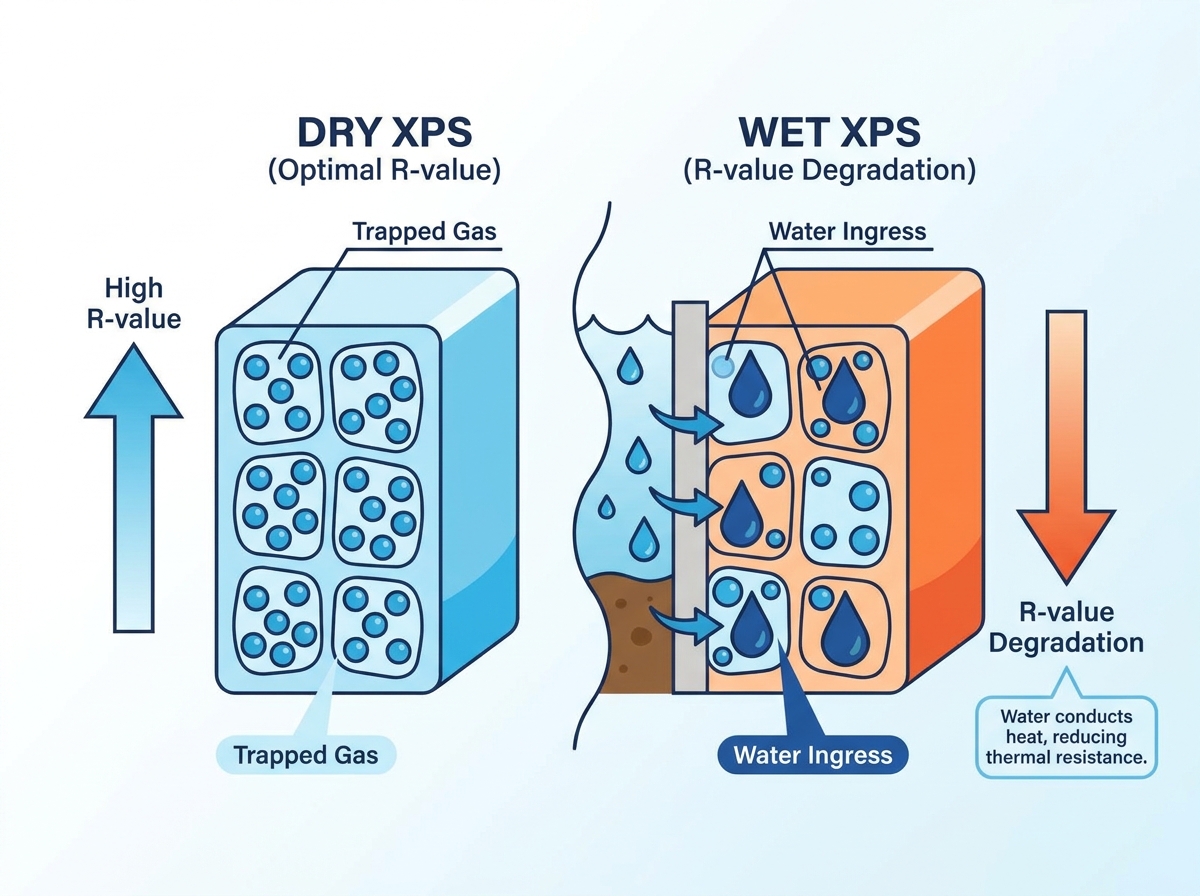
In below-grade, under-slab, and inverted roof applications, insulation boards face relentless moisture exposure. Water ingress fundamentally compromises thermal resistance. It slowly displaces insulating gases. It degrades your effective R-value. Specifiers and contractors constantly navigate conflicting marketing claims regarding moisture resistance. Standardized laboratory tests do not always mirror a 15-year real-world soil exposure scenario.
You need a reliable way to interpret material data. The primary goal of this guide is to provide a clear, evidence-based framework for evaluating XPS water absorption data. You will understand how standardized testing methodologies work. You will learn how to select the right rigid foam insulation without relying on manufacturer hyperbole. This ensures your building envelope performs efficiently over its entire design life.
Key Takeaways
Water replaces trapped gas: The primary threat of high water absorption is the displacement of insulating blowing agents, leading to direct R-value degradation.
Lab vs. Field context: The standard XPS immersion test is a baseline for quality control, but field-extraction data is necessary to evaluate true XPS long term water absorption.
Cellular integrity matters: Closed cell XPS water resistance relies on a continuous, extruded polystyrene matrix, but manufacturing quality and physical damage significantly alter real-world performance.
Holistic specification: Evaluating insulation requires balancing water absorption metrics with compressive strength and lifecycle cost analysis.
The Business and Performance Impact of XPS Water Absorption
Moisture fundamentally alters the physics of rigid foam insulation. The thermal penalty of water ingress is severe. Water conducts heat approximately 25 times faster than trapped air. It conducts heat even faster than specialized blowing agents. Water slowly enters the foam matrix over time. It displaces the insulating gases trapped inside the cells. This substitution accelerates R-value depletion. Your insulation essentially becomes a thermal bridge.
Certain application zones carry much higher risks for this thermal penalty. Water absorption metrics become mission-critical here. Below-grade foundation walls sit in constant contact against damp soil. Hydrostatic pressure physically forces water into microscopic material defects. Protected membrane roofs (inverted roofs) face similar threats. These assemblies endure brutal freeze-thaw cycles. Water expands when it freezes. This expansion physically ruptures cell walls. It creates larger pathways for future moisture ingress.
Ignoring these realities carries major operational implications. Specifying materials based on inaccurate moisture resistance assumptions guarantees future problems. Wet insulation forces HVAC systems into overdrive. They must consume excessive energy to maintain interior temperatures. This drives up monthly utility bills. Eventually, the failing envelope demands costly remediation. Digging out a foundation to replace saturated insulation is incredibly disruptive. It requires extensive labor, heavy machinery, and significant capital.
Demystifying the Standard XPS Water Absorption Test Methods
We must understand the laboratory standards governing insulation data. Manufacturers rely on standardized tests to report performance. However, lab environments differ vastly from wet soils.
The XPS Immersion Test (ASTM C272 / C272M)
The industry heavily references the standard XPS immersion test. This protocol (ASTM C272) measures baseline water absorption. Technicians submerge insulation samples completely underwater. They leave the samples submerged for 24 hours. Afterward, they measure the weight gain by volume. This test verifies basic manufacturing quality. It confirms the cellular structure holds up against short-term wetting.
You must acknowledge the limitations of this test. A 24-hour dunk does not replicate 15 years underground. It lacks the continuous hydrostatic pressure found deep in saturated soils. It completely ignores temperature cycling. The short duration primarily measures water entering the cut surface cells of the sample. It rarely measures deep interior penetration.
XPS Moisture Diffusion and Freeze-Thaw Testing (ASTM C1512)
Building envelopes endure extreme temperature swings. ASTM C1512 addresses these harsh realities. This standard tests structural integrity over time. It combines continuous moisture exposure and thermal cycling. Technicians subject the foam to alternating freezing and thawing temperatures while wet.
This protocol effectively tests XPS moisture diffusion. Water vapor diffuses slowly into the board. When temperatures drop, this trapped vapor freezes. The resulting ice expands. This expansion stresses the internal plastic matrix. Repeated cycles can degrade cell walls. Measuring absorption after these cycles reveals true structural durability.
Reading the Spec Sheet
Interpreting XPS insulation test data requires a critical eye. Never accept a blanket percentage blindly. Always investigate the context.
Identify the exact ASTM standard: Ensure the manufacturer specifies ASTM C272 or C1512.
Check the duration: Did they test for 24 hours, 96 hours, or 30 days?
Look for temperature parameters: Water temperature affects absorption rates.
Verify sample preparation: Cut edges absorb water faster than factory-skinned surfaces.
The Reality Check: Lab Data vs. XPS Long Term Water Absorption in the Field
Laboratory data only tells half the story. The insulation industry constantly debates the real-world performance of rigid foams. The "EPS vs. XPS" controversy dominates this discussion. Competing whitepapers often present conflicting narratives.
They argue over how these materials behave when buried for 10 to 15 years. Lab tests generally favor the extruded polystyrene structure. However, extended field conditions introduce complex variables. Continuous vapor drive forces moisture deep into materials. Wet-soil contact provides an endless water supply.
In-situ field extractions provide the most reliable evidence. Researchers dig up active sites after years of exposure. They extract insulation boards directly from wet foundations. They quickly seal the samples to prevent evaporation. Then, they weigh them in the lab. These extractions reveal true XPS long term water absorption rates.
Discrepancies frequently occur between 24-hour tests and decade-long extractions. A board might pass an immersion test with less than 0.3% absorption. Yet, the same board might show 4% or 5% absorption after 15 years underground. This happens because vapor drive operates differently than liquid immersion. Vapor slowly permeates the plastic matrix over years.
You must evaluate competitor claims skeptically. Marketing teams often cherry-pick data to favor their product.
They might compare aged, damaged XPS against brand-new EPS.
They might ignore varying soil drainage conditions between test sites.
They might extract samples from high-water-table areas and compare them to dry-climate sites.
Table 1: Contextual Differences in Absorption Data
Testing Environment
Primary Mechanism Tested
Duration
Predictive Reliability
Standard Lab Immersion (ASTM C272)
Capillary action, surface cell fill
24 hours
Low (for decadal performance)
Lab Freeze-Thaw (ASTM C1512)
Cell wall degradation, moisture diffusion
Weeks/Months
Medium to High
In-Situ Field Extraction
Vapor drive, hydrostatic pressure, freeze-thaw
5 to 15+ years
Highest (True real-world data)
How Closed Cell XPS Water Resistance Compares to Alternatives
Selecting the right material requires understanding the underlying physical structures. Each rigid foam type handles moisture differently.
XPS (Extruded Polystyrene)
The manufacturing process defines this material. Manufacturers extrude liquid polystyrene through a die. This creates a continuous, uniform closed-cell structure. The process leaves no interstitial voids between the cells.
This structure provides exceptional strengths. Closed cell XPS water resistance represents the gold standard for baseline capillary action defense. The tight matrix stops liquid water effectively. It also provides high compressive strength, making it ideal under heavy concrete slabs.
However, it has vulnerabilities. It remains susceptible to vapor drive over very long periods. Without proper drainage planes, trapped vapor eventually permeates the cells.
EPS (Expanded Polystyrene)
EPS manufacturing uses a different mechanism. Manufacturers place small polystyrene beads into a mold. They use steam to expand and fuse these beads together. This process creates potential interstitial spaces between the fused beads.
The moisture dynamics here are complex. EPS may absorb liquid water faster than XPS initially. The spaces between beads allow rapid capillary uptake. However, some field tests suggest EPS can also dry out faster. If environmental conditions change, the interstitial spaces allow moisture to escape. Proper soil drainage heavily dictates EPS success below grade.
Polyiso (Polyisocyanurate)
Polyiso offers the highest R-value per inch among rigid foams. Manufacturers typically face this foam with foil or fiberglass mats.
Its moisture dynamics limit its application scope. The foam core is highly vulnerable to moisture absorption. If water breaches the foil facer, the core acts almost like a sponge. Due to this severe vulnerability, engineers generally avoid recommending Polyiso for below-grade applications. XPS remains far superior in wet dirt.
Decision Framework: Specifying the Right Insulation Board
You cannot specify insulation based solely on product brochures. You need a systematic approach to mitigate moisture risks. Follow this framework to ensure optimal envelope performance.
Define the Moisture Load. Assess your specific site conditions. Identify the local water table depth. Evaluate the soil drainage capacity. Heavy clay soils trap water against foundations. Sandy soils drain quickly. Determine your climate zone. Assess the freeze-thaw risk accurately.
Require Independent Test Data. Do not rely on internal manufacturer summaries. Request third-party XPS water absorption test documents. Ensure the reports cover both short-term immersion and long-term freeze-thaw cycling. Demand transparency regarding test temperatures and sample preparation.
Mandate Proper Assembly, Not Just Products. Insulation never works alone. It functions as part of a broader assembly. Outline stringent waterproofing protocols. Pair your XPS with high-quality elastomeric waterproofing membranes. Install dimpled drainage boards over the insulation. Mandate clean, free-draining backfill practices. A robust drainage plane prevents hydrostatic pressure from building up against the foam.
Factor in Compressive Requirements. Balance moisture resistance with load-bearing needs. Beneath-slab applications demand specific compressive strengths. Evaluate whether you need 25 psi, 40 psi, or 60 psi boards. Dense boards often exhibit slightly better moisture resistance due to tighter cell structures. Ensure the selected board meets both structural and thermal demands.
Conclusion
Evaluating insulation performance requires moving beyond basic marketing claims. Moisture resistance is not a static number printed on a specification sheet. It represents a dynamic physical property. Real-world application, testing methodology, and time all influence final thermal performance.
The tight cellular structure of extruded polystyrene makes it a premium choice for hostile environments. However, successful projects require rigorous oversight. Specifiers must demand transparent, independent field extraction data. You must design holistic, well-drained assemblies. Proper waterproofing and drainage boards guarantee long-term R-value retention far more effectively than the foam board alone.
Your next step is critical. Consult directly with structural engineers and building envelope consultants. Review localized field-extraction data specific to your climate zone before finalizing any specification.
FAQ
Q: What is the standard XPS water absorption test?
A: The most common baseline test is ASTM C272. It involves measuring the volume and weight of the XPS board before and after a 24-hour full water immersion. Technicians use this data to calculate the percentage of water absorbed by volume.
Q: Does XPS insulation lose its R-value when wet?
A: Yes. While XPS is highly water-resistant, any long-term moisture that penetrates the cell structure displaces the insulating gases. Water conducts heat significantly faster than these gases, resulting in a diminished R-value.
Q: How does XPS long term water absorption compare to EPS in below-grade applications?
A: This remains highly contested. Lab immersion tests show XPS outperforming EPS due to its closed-cell structure. However, independent field-extraction studies suggest that over 15+ years in continuous wet conditions, XPS can retain absorbed moisture, whereas EPS may dry out more efficiently. Assembly design heavily dictates performance.
Q: What is XPS moisture diffusion?
A: Moisture diffusion refers to the slow process by which water vapor permeates the cellular structure of the XPS board over time. Vapor pressure differentials drive this process, making it distinctly different from liquid water absorption via capillary action.