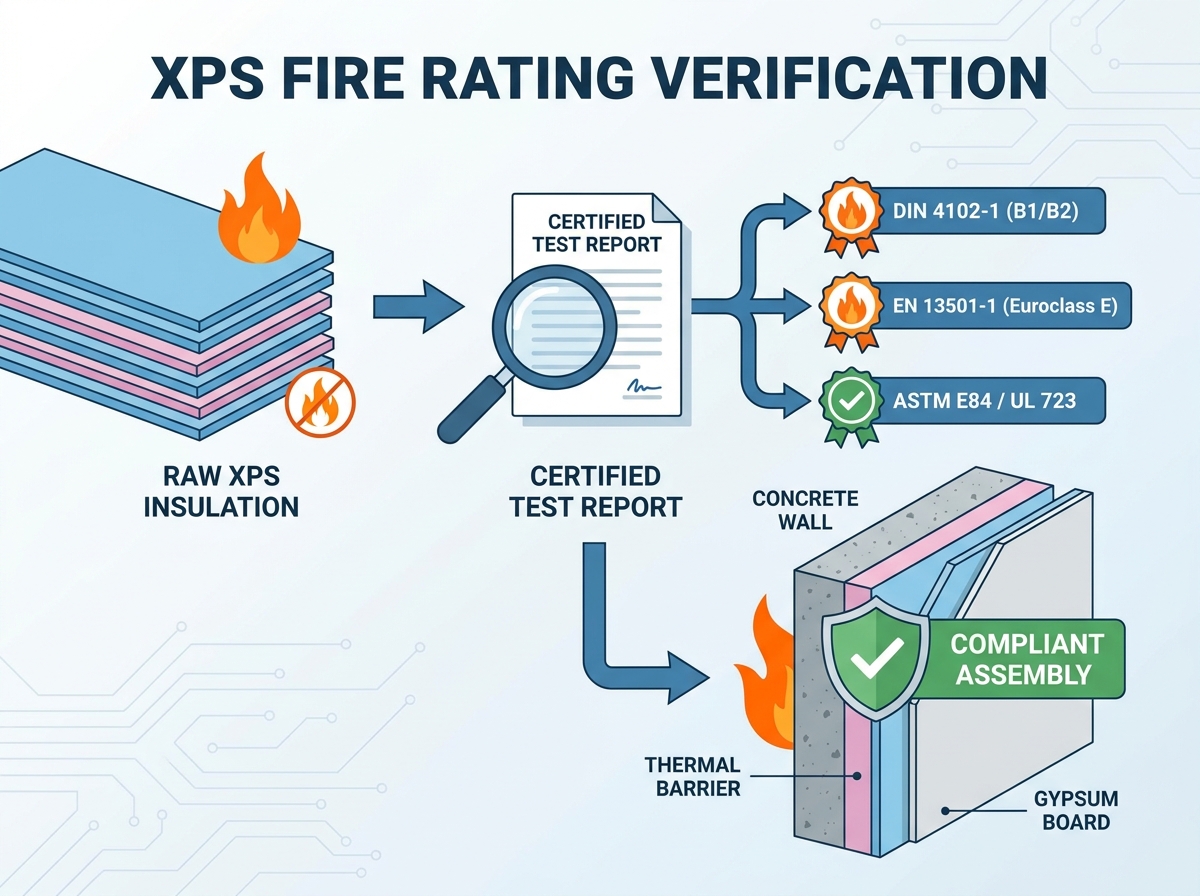
Specifying extruded polystyrene (XPS) for commercial builds or cold storage facilities carries significant compliance risks. You face massive legal liabilities if fire performance data is inaccurate or misunderstood by your procurement team. Untreated polystyrene is inherently combustible and burns rapidly. However, modern manufacturing utilizes chemical flame retardants to dramatically alter how the material reacts to extreme heat. This crucial chemical modification shifts it from a dangerous hazard to a highly efficient, code-compliant building envelope component. For procurement teams and construction contractors, selecting the correct insulation requires looking far past basic marketing claims. You must understand exactly what material you are installing on your buildings. This comprehensive guide breaks down how to verify an accurate XPS fire rating. We will decode confusing international classifications, outline strict auditing frameworks, and ensure supplier documentation aligns perfectly with local building codes.
Key Takeaways
XPS Fire Classification matters: Ratings like DIN 4102-1 (B1/B2) and EN 13501-1 (Euroclass E) dictate where and how the insulation can be legally installed.
Verification is non-negotiable: An authentic XPS fire test report from a certified, independent laboratory is required to clear building inspections and limit liability.
Application dictates protection: Even highly rated XPS flame retardant board typically requires a prescribed thermal barrier (like half-inch gypsum) when installed in occupied spaces.
Chemical compliance is shifting: Buyers must ensure the flame retardants used comply with modern environmental regulations (e.g., the phase-out of HBCD).
The Business Cost of Ignoring XPS Fire Safety Standards
Failing to verify fire ratings during procurement leads to devastating business consequences. You risk failed building inspections and costly project delays. If inspectors discover non-compliant insulation, they frequently mandate complete teardowns. This severely impacts your project timeline and budget. Furthermore, you face severe legal liability in the event of an actual fire. Insurance companies will deny damage claims if they find unauthorized or uncertified materials in the wall assembly.
Untreated XPS melts and propagates flame rapidly. It acts as a continuous fuel source when exposed to ignition. Buyers must actively differentiate between standard packaging-grade foams and specialized construction-grade materials. You need a properly treated XPS flame retardant board to ensure structural safety. These modified boards contain specific chemical additives. They disrupt the combustion process at a molecular level. They prevent the foam from spreading flames rapidly across a building facade.
To succeed, your insulation must meet specific technical indices. Regional building codes dictate strict limits. You must verify these limits before issuing any purchase orders. The insulation must achieve these safety benchmarks without compromising core performance. Procurement teams must follow strict success criteria:
Verify the flame spread index matches regional building code minimums.
Check smoke development limits to ensure safe evacuation routes.
Ensure thermal resistance (R-value) remains stable despite chemical additives.
Confirm long-term moisture resistance for underground or wet applications.
Decoding Global XPS Fire Classifications
Mapping the alphabet soup of testing standards is a vital procurement step. You need to know exactly what specifications to demand from your suppliers. Different regions rely on distinct testing frameworks. They use various laboratory methods to evaluate an accurate XPS fire classification. Understanding these variations helps you source materials globally while remaining locally compliant.
Understanding the XPS B1 B2 Rating (DIN 4102-1)
The German DIN 4102-1 standard categorizes material flammability extensively. Many international markets outside of Germany still reference the XPS B1 B2 rating due to its historical reliability.
B2 designates a "normally flammable" material. It serves as the baseline minimum standard for general construction. It will burn under a direct flame. However, it self-extinguishes rapidly when you remove the primary flame source. B1 stands for "hardly flammable." It contains much higher concentrations of flame retardants. This rating is ideal for stricter commercial requirements. High-rise projects often mandate B1 materials. B1 foams resist ignition longer. They also limit the upward spread of flames significantly better than B2 variants.
Navigating the XPS Euroclass E System (EN 13501-1)
European markets rely heavily on the EN 13501-1 standard. This modern framework introduced the XPS Euroclass E rating. It remains the standard classification for most architectural foam used in Europe today.
The laboratory test exposes the foam edge to a small flame for 15 seconds. An E rating indicates an acceptable, limited reaction to this small ignition source. However, the bare material usually requires external protection in real life. You must cover it using other non-combustible building materials. Concrete, brick, or thick gypsum are common protective layers in the final wall assembly. By contrast, Euroclass F means the product failed the test or went entirely untested. You should strictly avoid F-rated boards for building applications.
North American Standards (ASTM E84 / UL 723)
In North America, ASTM E84 and UL 723 govern the insulation market. These tests utilize a large Steiner Tunnel. They measure how far and how fast flames travel across the surface.
Inspectors evaluate two main metrics. They look at the Flame Spread Index (FSI) and the Smoke Developed Index (SDI). A typical commercial building requirement demands an FSI of 75 or less. The SDI must remain at 450 or less. Foam plastics almost always require separation from the interior space. Even if they achieve excellent FSI scores, building codes prohibit leaving them exposed indoors.
Global Insulation Fire Standard Comparison
Standard Region
Primary Test Method
Key Rating Categories
Typical Application Benchmark
Germany / Global
DIN 4102-1
B1, B2, B3
B2 (Minimum), B1 (Commercial)
European Union
EN 13501-1
Euroclass A through F
Class E (When used in assemblies)
North America
ASTM E84 / UL 723
Class A, B, C (FSI/SDI)
FSI < 75, SDI < 450
How to Audit an XPS Fire Test Report
A skeptical, step-by-step framework protects your project from massive liabilities. You must evaluate manufacturer claims carefully. This vigilance protects you against forged or outdated compliance documents. When reviewing an XPS fire test report, you must follow strict auditing rules.
Verify the Issuing Body
Always ensure the test comes from an accredited third-party agency. Recognized laboratory names include UL, Intertek, SGS, and TÜV. Internal company tests do not carry legal weight. Code officials will reject documents lacking independent laboratory stamps. You must verify the laboratory credentials online to prevent fraud.
Check Testing Parameters
Did the laboratory test the specific thickness you are buying? Fire performance changes drastically based on material volume. A 20mm board behaves very differently than a 100mm board during a fire. Thicker boards contain more total combustible mass. Always match the test report parameters to your purchased dimensions. Never accept a 50mm test report for a 150mm insulation order.
Date and Chemical Relevance
Reports older than three to five years raise immediate red flags. They often reflect phased-out chemical formulations. Environmental laws evolve constantly around the globe. Manufacturers frequently change flame retardant recipes to maintain compliance. Require recent documentation showing current production runs. A valid certificate from 2015 does not cover a board produced today.
Matching Batch Numbers
Finally, ensure certification matches your physical delivery. The production batch numbers on the shipping documents must match the laboratory certificates. Inspect the stamps on the actual foam boards when they arrive on site. If the numbers disconnect, you cannot prove compliance to a rigorous building inspector.
Installation Realities: Code Compliance Beyond the Board
Bridging the gap between inherent material ratings and real-world compliance is tricky. You must understand strict XPS fire safety standards within the complete wall assembly context. A single component does not dictate the safety of the entire building system.
The Thermal Barrier Requirement
Clarify early on that "flame retardant" does not mean "fireproof." All polystyrene foams will melt when exposed to high heat. Most international building codes strictly regulate interior foam use. They require physical separation from building interiors. You must install an approved thermal barrier over the insulation. A standard half-inch drywall sheet typically meets this mandatory code requirement. This barrier delays heat transfer effectively. It provides occupants crucial minutes to escape safely during a fire emergency.
Continuous Exterior Insulation
Exterior Insulation and Finish Systems (EIFS) have unique fire safety demands. You must use fire blocking and compartmentalization techniques. Cavity walls create a dangerous chimney effect. Flames can shoot upward rapidly if left unchecked behind the cladding.
Best practices require installing horizontal and vertical fire barriers. You must install non-combustible mineral wool strips at specific intervals. These methods prevent dangerous cavity fires behind the facade. They compartmentalize the exterior wall system effectively and meet strict NFPA 285 standards in North America.
Cold Storage Applications
Sandwich panels dominate modern refrigeration facilities. These environments demand extreme moisture resistance. XPS excels at stopping vapor drive in commercial freezers. However, you must balance these moisture needs with strict facility fire codes.
Cold storage detailing requires meticulous attention from contractors. You must seal panel joints perfectly. Exposed foam edges represent significant vulnerabilities during hot work or electrical faults. Improperly protected foam in food processing facilities has historically led to massive financial losses. Always consult specialized cold storage insurance guidelines before specifying materials.
Environmental Regulations vs. Flame Retardant Efficacy
The intersection of building safety and environmental compliance demands your immediate attention. Chemical regulations change rapidly across the globe. You must ensure your materials meet both life-safety fire codes and ecological standards.
The Phase-out of HBCD
Hexabromocyclododecane (HBCD) was historically the primary flame retardant used in polystyrene manufacturing. It worked exceptionally well for basic fire safety. However, authorities banned it in many regions due to severe environmental toxicity. HBCD is a recognized persistent organic pollutant (POP). It accumulates in the environment and harms local wildlife. It also poses risks to human health during manufacturing and end-of-life disposal.
Evaluating Modern Alternatives
Polymeric flame retardants (pFR) are the new global industry standard. They offer a much safer ecological profile. Their molecular size is simply too large to pass through biological cell membranes. This structural change eliminates the dangerous bioaccumulation risks associated with older chemicals.
Buyers must verify their supplier uses environmentally compliant retardants. Do not buy obsolete inventory containing banned chemicals to save money. Modern pFR chemicals still easily achieve strict fire safety benchmarks. They maintain excellent thermal and physical properties over decades of continuous use.
Conclusion
Sourcing insulation requires a delicate, informed balance. You must weigh thermal performance and structural integrity against strict compliance limits. Basic marketing brochures hold absolutely zero value during a strict fire marshal inspection. Relying on them invites disaster.
Your shortlisting logic should be ruthless and uncompromising. Eliminate suppliers who fail basic document checks immediately. If they cannot provide a current, verifiable, third-party report matching your exact product thickness, walk away. Compromising on safety documentation invites disastrous legal and financial consequences for your business.
Next steps for procurement teams are highly straightforward. Advise your staff to request technical data sheets (TDS) and safety data sheets (SDS) early in the sourcing process. Ask for certified fire certificates before requesting a price quote. Finally, always consult with local fire marshals or code officials on assembly-specific requirements. Proactive verification ensures your projects remain safe, compliant, and legally sound.
FAQ
Q: What is the difference between B1 and B2 XPS fire ratings?
A: B1 is "hardly flammable" and resists fire spread much better than B2, which is categorized as "normally flammable." B1 is typically mandated for commercial high-rises or strict municipal codes. Meanwhile, B2 is more common in residential projects or highly protected, enclosed wall assemblies.
Q: Is an XPS Euroclass E rating sufficient for exterior walls?
A: Yes, but only when used as part of a thoroughly tested wall assembly. Euroclass E indicates the bare material's reaction to fire. It must be covered by a non-combustible facade or an approved thermal barrier to meet full building safety codes.
Q: Does flame-retardant XPS insulation lose its fire rating over time?
A: Modern polymeric flame retardants are chemically bound or stably integrated into the polystyrene matrix. They generally do not degrade or off-gas at a rate that would compromise the fire rating over the expected lifespan of the building.
Q: How does the fire rating of XPS compare to EPS or Polyiso?
A: Both XPS and EPS require flame retardants to achieve B1/B2 or Euroclass E ratings and behave similarly in fire by melting and shrinking. Polyiso is a thermoset plastic. It chars rather than melts, generally offering higher inherent fire resistance without a thermal barrier in specific applications.