- All
- Product Name
- Product Keyword
- Product Model
- Product Summary
- Product Description
- Multi Field Search


Specifying the right insulation core for a refrigerated truck body requires balancing thermal performance with structural integrity and payload weight limits. Engineers face immense pressure to design lighter composite panels. Extruded polystyrene (XPS) offers superior moisture resistance and compressive strength compared to traditional EPS. It handles the harsh realities of highway transit exceptionally well. However, selecting the wrong density or failing to account for skin compatibility often leads to delamination and thermal drift. We built this guide to help you navigate these exact engineering challenges.
Our objective is to provide engineering and procurement teams with a highly objective, specification-driven framework for evaluating XPS foam for refrigerated truck panels. You will learn how to match foam densities to specific vehicle zones. We will show you how to calculate precise thicknesses for your regional climate. This approach ensures long-term performance under dynamic transit conditions. It maximizes vital cargo capacity while protecting perishable goods.
Thermal vs. Structural Balance: Specify density based on application zone—floors require high compressive strength (often 500+ kPa), while walls prioritize lower weight.
Bonding Matters: Unprepared XPS surfaces lead to catastrophic panel failure; specify grooved, sanded, or planed finishes to ensure adhesive mechanical lock.
Thickness Precision: Base thickness on regional climate extremes and cargo requirements (chilled vs. deep freeze) to avoid payload-reducing over-specification.
Supplier Verification: Always request batch-level testing data for thermal conductivity (K-value) and water absorption rates, as manufacturing variances are common.
Establishing strict baseline metrics is non-negotiable for composite panel engineering. Failing to set these parameters results in either immediate thermal leakage or excessive panel weight. Thermal leakage introduces severe spoilage risks for sensitive cargo like pharmaceuticals and fresh produce. Conversely, heavy panels severely reduce legal payload capacity. They increase fuel burn rates on every route. You must control these factors from the start by setting rigorous laboratory benchmarks.
Engineers typically target a standard K-value around 0.028 to 0.030 W/m·K at standard test conditions. This metric dictates how well the foam resists heat transfer across the truck wall. However, you must carefully account for a phenomenon called "thermal drift." As foam ages in the real world, the blowing agents inside its cells slowly diffuse outward. Air gradually replaces these heavy gases. This physical exchange marginally reduces the initial insulation value over time. You should always ask suppliers for aged K-value test results. This data helps you accurately model long-term refrigerated truck XPS insulation performance across a ten-year chassis lifespan.
Moisture represents the absolute enemy of thermal resistance. XPS holds a distinct closed-cell advantage here over expanded polystyrene (EPS) or open-cell polyurethanes. It typically exhibits water absorption rates of less than 1% by volume under total immersion tests. This specific metric remains critical for maintaining long-term thermal resistance in high-humidity logistics. Condensation builds rapidly inside refrigerated trailers during loading and unloading cycles. When core materials absorb water, their thermal conductivity spikes instantly. Water transfers heat exponentially faster than trapped gas. A dry core guarantees cold cargo.
Commercial trucks experience brutal temperature fluctuations daily. A vehicle might load in freezing warehouse conditions and drive directly through a scorching desert highway. You must thoroughly address dimensional stability. This metric measures the maximum percentage a material expands or shrinks under heat and cold extremes. High dimensional stability prevents dangerous warping within the composite structure. Materials expand at different rates. Aluminum skins expand faster than foam cores. If the core shifts significantly during these thermal cycles, the panel will tear itself apart internally.
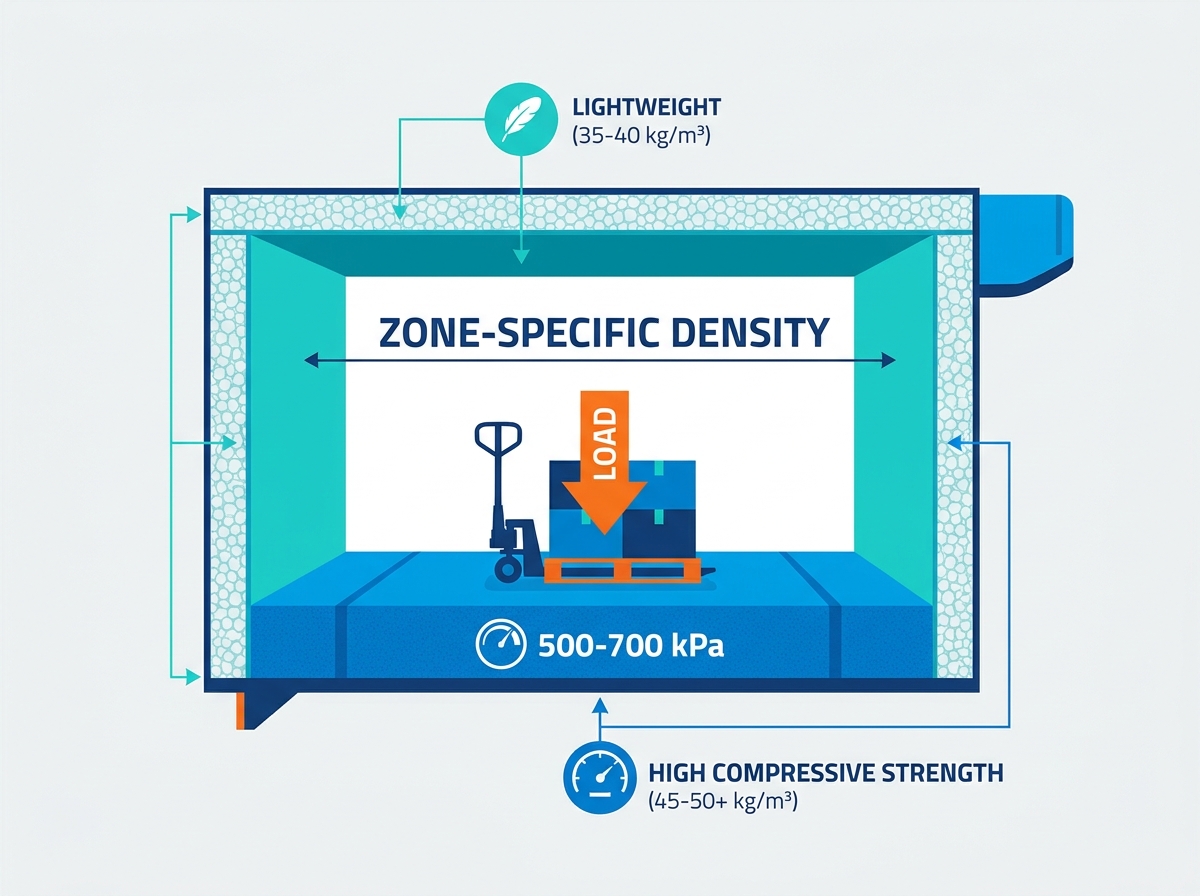
A one-size-fits-all density approach fails miserably in truck manufacturing. It inevitably leads to structural failure or unnecessary material expenses. The XPS sandwich panel core must be specified according to its exact physical location in the truck body. Different zones experience radically different mechanical loads.
For XPS truck wall insulation and roof panels, the typical density ranges between 35 and 40 kg/m³. You want to focus heavily on lightweight properties here. Lower density maximizes internal cargo capacity. It keeps the vehicle under strict weigh-station limits. Yet, this density still maintains enough rigidity against aerodynamic wind shear. It resists constant road vibration effectively. Roof panels face additional solar heat gain, but they rarely face heavy physical impacts. Therefore, a lighter 35 kg/m³ density perfectly balances thermal isolation and weight savings.
Trailer floors face brutal daily punishment. XPS refrigerated truck floor insulation needs a typical density range of 45 to 50+ kg/m³. You must mandate exceptionally high compressive strength for these floor composites. Specifications often demand 500 kPa to 700 kPa ratings. The floor must withstand severe dynamic point loads daily. Motorized pallet jacks weigh thousands of pounds. Forklifts driving into the trailer apply massive stress to tiny wheel contact patches. Heavy static cargo pallets create localized pressure points. If you specify weak floor foam, the core will crush instantly. Crushed foam creates floor depressions, tearing the fiberglass surface and ruining the trailer.
Required internal temperatures directly dictate your baseline XPS panel thickness selection. You cannot guess this dimension. It requires precise thermal modeling based on the specific cargo profile of the logistics operator.
Different supply chains demand different internal climates. Fresh and chilled goods usually need temperatures between 0°C and 5°C. For these applications, you generally specify thicknesses ranging from 50mm to 80mm. Frozen goods operate in a much harsher range. They typically require -18°C to -25°C. These deep-freeze environments require panels between 100mm and 120mm or more. Specialized pharmaceutical transport often demands ultra-thick panels to maintain highly sensitive vaccine temperatures across deserts.
Converting K-value to total R-value remains straightforward but vital. You calculate the total panel thermal resistance by combining the XPS core thickness with the thermal properties of the inner and outer skins. Skins might use FRP (Fiberglass Reinforced Plastic), aluminum, or CFRT (Continuous Fiber Reinforced Thermoplastic). You divide the thickness (in meters) by the K-value to find the R-value of the foam itself. Then, you add the specific R-values of the skins and any intermediate adhesive layers. This provides the total composite R-value required for HVAC sizing.
Diminishing returns constantly plague excessive thickness. Every extra millimeter of foam directly reduces the internal cubic volume available for freight. Over-specifying thickness eats into payload space on every single trip. Do not build a 120mm panel if the truck only transports fresh cut flowers. Furthermore, excessively thick panels require wider perimeter extrusions and heavier framing. This adds unnecessary dead weight to the vehicle chassis.
The most common catastrophic failure in refrigerated composite panels is skin delamination. Poor core adhesion or trapped off-gassing usually causes this structural separation. XPS core bonding for insulated trucks demands precise engineering and strict environmental controls.
Never use "smooth skin" XPS directly from the extrusion line. Smooth, untouched surfaces actively reject structural adhesives. They lack the necessary microscopic texture. You must mandate specifying sanded, planed, or slotted/grooved XPS surfaces. These physical modifications exponentially increase the available surface area. They create a strong mechanical grip for adhesives to anchor into securely. A sanded panel absorbs the primer and adhesive, creating an unbreakable composite matrix.
We evaluate common adhesive systems closely before any production run. Polyurethane-based (PU) and epoxy systems dominate the modern manufacturing market. They interact very well chemically with XPS. You must note the severe risk of solvent-based adhesives. Solvents will melt and degrade the polystyrene cell structure instantly. If a worker applies a solvent-based glue, the foam dissolves into a useless paste. Always request chemical compatibility charts from your adhesive supplier.
A perfect adhesive formulation fails rapidly in poor atmospheric conditions. Lamination requires strict environmental control. You need sophisticated vacuum pressing or continuous lamination equipment. You must monitor ambient humidity and factory temperature closely. Moisture in the air can cause PU adhesives to foam prematurely. Cold temperatures prevent proper curing. Controlling these variables ensures a permanent, void-free bond across the entire massive panel surface.
Separating marketing hype from reliable manufacturing capability takes sustained effort. You cannot rely on brochures alone. Procurement teams must audit potential suppliers using rigorous engineering standards.
You must verify actual production tolerances continuously. Specify acceptable thickness tolerances tightly. We recommend a strict ±1mm maximum variance. Uneven foam thickness creates dangerous weak spots during the vacuum pressing stage. It leads to poor lamination pressure and trapped air pockets. These air pockets expand in the sun, pushing the fiberglass skin away from the core.
Table: Standard Quality Tolerances for Refrigerated Truck Foam
Verification Category | Key Metric Requirement | Risk if Ignored |
|---|---|---|
Thickness Tolerance | ±1.0 mm maximum | Uneven lamination pressure, air voids |
Density Consistency | ±5% variance per batch | Localized crushing under floor loads |
Thermal Performance | Verified aged K-value | Unexpected thermal leakage over time |
Surface Roughness | Planed or sanded evenly | Complete adhesive delamination |
Look for globally recognized quality markers. ISO 9001 demonstrates basic factory quality management. DIN standards ensure rigorous physical testing methods are followed. Specific transportation approvals like ATP certification remain absolutely critical for refrigerated transport across Europe. Ensure your supplier holds current, verifiable certificates.
Do not rush fleet-scale procurement based on a single spreadsheet. Follow a systematic validation process. We recommend executing the following steps:
Request small physical samples of the targeted density.
Demand third-party lab testing reports verifying the exact compressive strength.
Conduct small-batch lamination tests in your own facility.
Subject the test panels to extreme heat and cold cycling.
Perform a destructive pull-test to verify the adhesive breaks the foam, not the bond line.
Prove the bonding compatibility completely before committing to a massive fleet order.
Specifying XPS is never just about ordering generic foam blocks. It requires engineering a comprehensive, interconnected composite system. The inner core interacts dynamically with fiberglass skins, structural adhesives, and changing environmental loads every single day.
Define density strictly per zone to balance overall truck weight and floor durability.
Mandate physical surface treatments like sanding or grooving to guarantee permanent adhesive bonding.
Calculate precise thickness profiles matched exactly to your specific thermal cargo goals.
Test adhesive chemical compatibility on small batches before large-scale production begins.
By following these specific steps, manufacturers build lighter, much more durable refrigerated trucks. These vehicles perform reliably for years. They maximize operational payload capacity and protect sensitive cargo efficiently for end-users across the globe.
A: XPS generally offers better structural rigidity and significantly lower water absorption. It provides more consistent density control during continuous panel lamination. While PU can offer slightly better initial thermal resistance, XPS maintains its core integrity better in high-moisture environments. It rarely suffers from internal rotting or waterlogging if the outer skin breaches during an accident.
A: Floor insulation typically requires a minimum of 400 to 500 kPa. You need this extreme strength to safely support the dynamic weight of motorized pallet jacks. Forklifts apply massive point loads through tiny wheels. If the core drops below this threshold, it risks sudden crushing, which leads immediately to surface delamination.
A: Yes, you can bond FRP directly to it. However, the XPS surface must be properly prepared first. Sanding or grooving is strictly mandatory. You must also use a highly compatible, non-solvent-based structural adhesive. A two-part PU adhesive system works exceptionally well to ensure a permanent, void-free composite bond.
A: High-quality XPS panels can easily maintain structural and thermal integrity for 10 to 15 years. This successfully matches the standard lifecycle of the heavy truck chassis itself. Achieving this long lifespan requires proper lamination techniques and rigorous edge-sealing. Keeping all road moisture out of the core guarantees long-term thermal performance.


