- All
- Product Name
- Product Keyword
- Product Model
- Product Summary
- Product Description
- Multi Field Search


Incorrectly installed Extruded Polystyrene (XPS) traps moisture rapidly. This single error creates incredibly high stakes for building durability. You will face hidden mold, severe structural rot, and severely degraded indoor air quality over time. Ignoring these moisture dynamics leads to disastrous consequences for any building envelope.
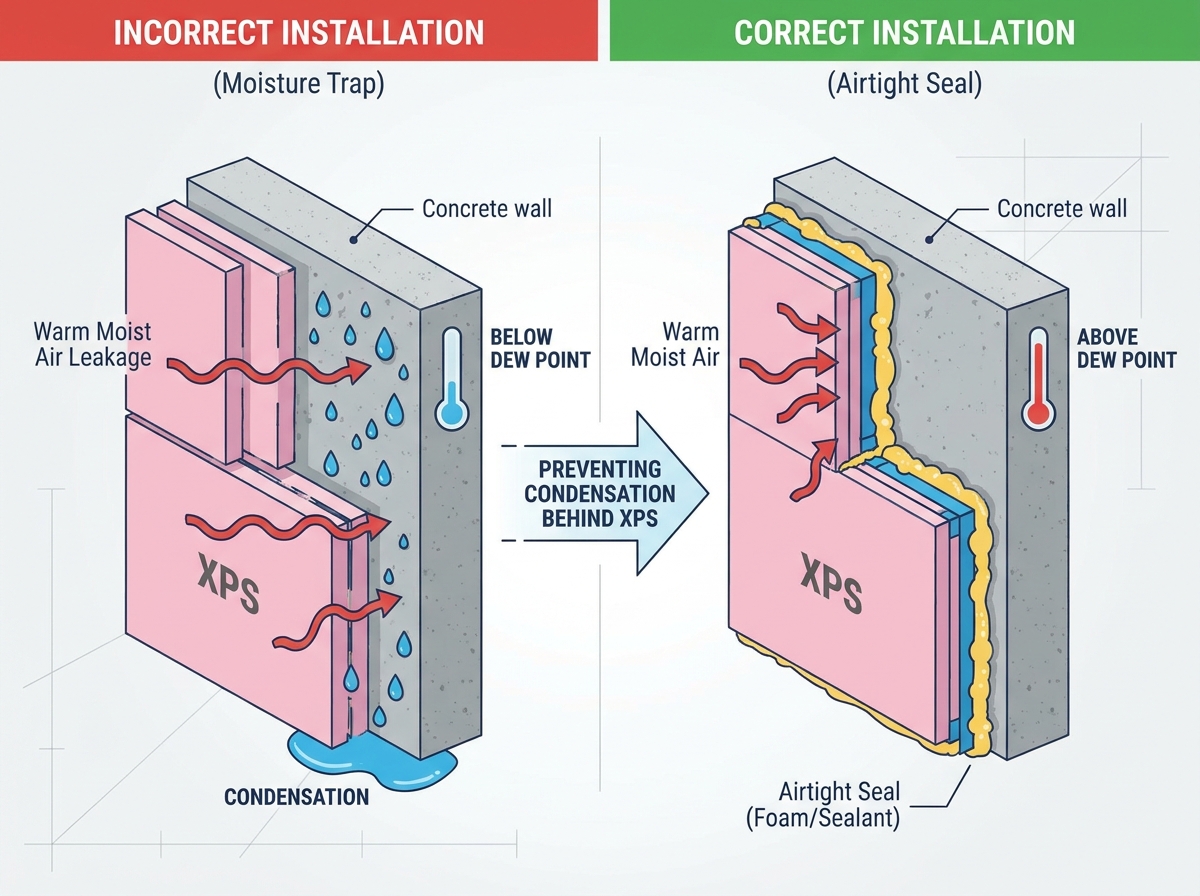
Fundamentally, XPS is highly moisture-resistant. Problems only occur when warm, moist air bypasses the foam. This humid air eventually hits a cold surface behind the foam. The surface might be a concrete foundation wall or wood exterior sheathing. When air hits this cold plane, it drops its water content instantly. This physical reaction creates relentless unseen moisture buildup.
This article provides an evidence-based, building-science framework for your project. We will help you evaluate your current thermal boundaries. You will learn to calculate essential thermal requirements accurately. Ultimately, our goal is to help you execute a completely moisture-proof rigid foam installation. Proper execution protects your home indefinitely.
Airtightness over R-value: Stopping air movement is more critical than thermal resistance for preventing moisture buildup behind rigid foam.
Mind the Dew Point: XPS thickness must be calculated based on your climate zone to ensure the condensing surface stays above the dew point.
Avoid the Double Barrier Trap: Combining XPS with interior poly sheeting often creates a moisture trap; understand your assembly's drying potential before adding a dedicated XPS vapor barrier.
Seal Every Seam: Taping joints is insufficient for uneven surfaces; acoustical sealant or expanding foam is required for true perimeter isolation.
Understanding vapor drive physics remains crucial for any retrofitting project. Vapor drive pushes moisture from warm, high-pressure zones toward cold, low-pressure zones. The air inside your home holds significant water vapor. Condensation forms when this moisture-laden air reaches a cold surface and drops below its saturation threshold. We call this critical temperature the dew point. When warm air meets cold sheathing, water droplets form instantly. Properly designing interstitial condensation insulation requires interrupting this exact process.
Many builders fail to calculate the XPS insulation dew point accurately. Inadequate foam thickness causes catastrophic failures. Thin foam allows the back side of the XPS to become freezing cold. Warm air touches this cold backside and condenses immediately. You must keep the condensing surface warm enough to prevent this state change.
Furthermore, XPS acts as a Class II vapor retarder at specific thicknesses. A one-inch board slows vapor diffusion but does not stop it entirely. Moisture slowly permeates the foam over time. Two-inch boards provide much stronger resistance. They act more like a true barrier. You must factor this permeability into your overall wall design.
Most people blame diffusion for wet walls. In reality, air leakage causes 90% of moisture problems behind rigid foam boards. Vapor diffusion moves moisture incredibly slowly. Air leakage moves moisture rapidly through small gaps at edges and joints. A tiny unsealed crack carries hundreds of times more water vapor than diffusion through the foam itself. Stopping air movement remains your absolute highest priority.
Climate dictates how you must design your XPS wall insulation assembly. Applying southern strategies in northern climates destroys buildings. You must match your materials to regional environmental pressures.
In cold zones, the risk profile involves outward vapor drive. Moisture moves from the warm, heated interior toward the freezing exterior. The primary success criterion is thermal thickness. The XPS must be thick enough to keep the interior face of the exterior sheathing warm. If the sheathing stays above the dew point, interior moisture will not condense there. You must push the dew point completely outside the structural wall cavity.
Warm and humid climates flip the physics entirely. The risk profile features inward vapor drive. Searing hot, humid exterior air pushes moisture toward the heavily air-conditioned interior. Here, your assembly must allow drying to the inside. You must strictly avoid any interior vapor barriers. Installing polyethylene on the inside of an air-conditioned building traps massive amounts of water in the wall.
You cannot treat foundations like exterior wood walls. Concrete foundation walls face an infinite moisture source from the surrounding soil. They constantly wick moisture via capillary action. Wood-framed exterior walls rely on weather-dependent drying cycles. Basement insulation must stop bulk water and soil vapor. Above-grade walls must manage seasonal humidity swings and wind-driven rain.
Climate Zone XPS Strategies
Climate Type | Vapor Drive Direction | Primary Moisture Risk | Recommended XPS Strategy |
|---|---|---|---|
Cold (Heating) | Interior to Exterior | Cold exterior sheathing condensation | Thick XPS outside, permeable inside |
Warm (Cooling) | Exterior to Interior | Air conditioning condensation inside wall | No interior barrier, breathable finishes |
Mixed | Reverses Seasonally | Trapped moisture both directions | Smart vapor retarders, moderate XPS |
Implementation details separate dry buildings from rotting structures. Preventing condensation behind XPS insulation requires strict adherence to building science protocols. You cannot cut corners on air sealing or foam thickness.
You must follow the International Residential Code (IRC) guidelines for minimum R-value and thickness ratios. These codes control the condensing surface temperature effectively. For example, in Marine Zone 4, the IRC requires R-5 continuous insulation over 2x4 walls. In Zone 6, you need R-7.5 to R-11 continuous insulation. Applying less than the code dictates guarantees a cold surface. A cold surface guarantees moisture. Do not guess your foam thickness; calculate it using localized climate data.
Standard construction tape often fails over time. Dusty, dirty XPS boards reject acrylic adhesives. As the tape peels away, massive air leaks develop. You must transition from simple taping to robust sealing. We recommend canned expanding polyurethane foam for perimeter gaps. Use heavy acoustic sealant for bottom plates and concrete joints. Mechanical air sealing prevents convective loops. Convective loops pull room air behind the foam, completely defeating your hard work.
Many homeowners attempt the "cut-and-cobble" method. They cut rigid foam blocks to fit tightly between wood studs. This method boasts a staggering failure rate. Wood framing shrinks, twists, and expands seasonally. As the wood moves, it pulls away from the rigid foam. Massive air gaps open up on every single side of the stud block. Warm air floods these gaps and rots the studs. We strongly advocate for continuous exterior or continuous interior application wherever physically possible.
The industry constantly argues about whether rigid foam needs extra plastic sheeting. Adding an XPS vapor barrier haphazardly destroys wall assemblies. You must understand material permeance before acting.
Permeance measures how easily water vapor moves through a material. One inch of XPS typically rates around 1.0 perm. This makes it a semi-permeable retarder. It slows moisture but breathes slightly. However, two inches of XPS drops the rating to 0.5 perms or lower. At this thickness, it blocks almost all vapor. You do not need secondary plastic sheeting when using two-inch foam.
Specific scenarios require supplemental barriers. Extremely cold climates (Zone 7 or 8) face immense wintertime vapor drive. High-humidity indoor environments demand strict controls as well. Indoor pools, commercial kitchens, and hot tub rooms generate massive moisture loads. These unique spaces need dedicated barriers to protect the framing.
A double barrier trap destroys homes rapidly. This occurs when you combine thick XPS on the outside with a 6-mil polyethylene sheet on the inside. If water enters the wall cavity from a roof leak or window flashing failure, it cannot dry. It cannot move out through the foam. It cannot move in through the plastic. The water sits inside the wall and rots the wood completely. You must always ensure your assembly can dry in at least one direction.
Modern building science relies on intelligent materials. For optimal XPS interior wall moisture control, recommend "smart" vapor retarders. Products like Intello or MemBrain change their permeability based on ambient relative humidity. In winter, they tighten up to block outward vapor drive. In summer, their pores open up. This allows inward-driven moisture to escape into the air-conditioned space safely. Smart retarders eliminate the dreaded double-barrier trap entirely.
Even well-intentioned installations fail occasionally. Preventing serious condensation behind XPS wall insulation means catching early warning signs. You must know how to diagnose and fix failing systems before structural damage sets in.
You can evaluate existing assemblies without tearing down drywall immediately. Look for subtle environmental clues. Musty odors in basements indicate active fungal growth behind the walls. Check for damp drywall at the baseboards. Look for moisture pooling at the sill plate. If baseboards warp or paint bubbles near the floor, water is running down the back of your foam and exiting at the bottom.
The rim joist represents the most common failure point for rigid board insulation. The geometry involves numerous right angles, joist hangers, and pipes. Cutting rigid foam to fit these complex shapes perfectly is nearly impossible. Air bypasses the foam blocks easily. We recommend transitioning away from rigid board in this specific area. Use closed-cell spray foam for rim joists. Spray foam conforms to the geometry perfectly and creates an impenetrable air seal.
Deciding how to fix a failing wall requires a careful cost-benefit analysis. Sometimes, you face a complete teardown. If the wood studs show advanced rot, you must remove everything. However, targeted interventions work for mild cases. You can improve interior dehumidification to reduce the vapor drive pressure. You can remove the baseboards and inject expanding foam to seal bottom-plate air leaks. Evaluate the extent of the damage before swinging a sledgehammer.
Complex moisture problems often exceed DIY capabilities. When hiring contractors, do not settle for standard carpenters. Look for building envelope professionals. Shortlist contractors who hold BPI (Building Performance Institute) certifications. They should utilize advanced diagnostic tools. Demand thermography (infrared camera) inspections to find hidden cold spots. Require blower door testing to quantify your home's actual air leakage rates.
Preventing moisture issues requires more than just buying thick foam boards. It demands managing the delicate relationship between temperature, humidity, and airtightness. You cannot simply maximize R-value and expect good results. Air sealing proves far more critical than thermal resistance alone.
We reiterate the absolute necessity of a holistic assembly approach. Treat your wall as a complete system. XPS serves as an excellent material, but it is not a standalone magic bullet. It relies on proper flashing, smart vapor retarders, and meticulous joint sealing to function correctly.
Before purchasing any materials, take one crucial next step. Consult your local building codes. Look up your specific climate zone requirements. Calculate the exact dew point thresholds for your area. Armed with localized data, you can build a wall assembly that stays perfectly dry for decades.
A: It depends heavily on climate and foam thickness. Thin XPS allows some vapor diffusion, but two-inch XPS acts as its own vapor retarder. Adding interior polyethylene often creates a double-barrier moisture trap. You typically only need supplemental barriers in extreme cold climates or high-humidity rooms like indoor pools.
A: Water behind basement foam generally comes from two sources. Capillary action wicks liquid water directly through the porous concrete from damp soil outside. Alternatively, warm interior basement air bypasses unsealed foam joints and condenses against the freezing concrete wall.
A: No. Leaving an air gap between XPS and a cold concrete wall creates a convective loop. Warm room air enters the gap, drops its moisture on the concrete, cools down, and sinks. This continuous cycle exacerbates condensation and promotes rapid mold growth.
A: Taped seams are rarely waterproof long-term. Construction tape adhesives degrade when applied to dusty or uneven foam surfaces. For true waterproofing and air sealing, you must rely on liquid flashing, acoustic sealants, or expanding polyurethane foam at all joints.
A: XPS provides a higher R-value per inch and significantly lower moisture permeance than EPS (Expanded Polystyrene). EPS breathes much more easily. If you need a breathable assembly that dries quickly, EPS works well. If you need strict moisture blocking, XPS performs better.


